
Suitable materials
Advanced alloys, semiconductors, thin films, interfaces, precipitate-containing materials, and other suitable needle-preparable specimens.
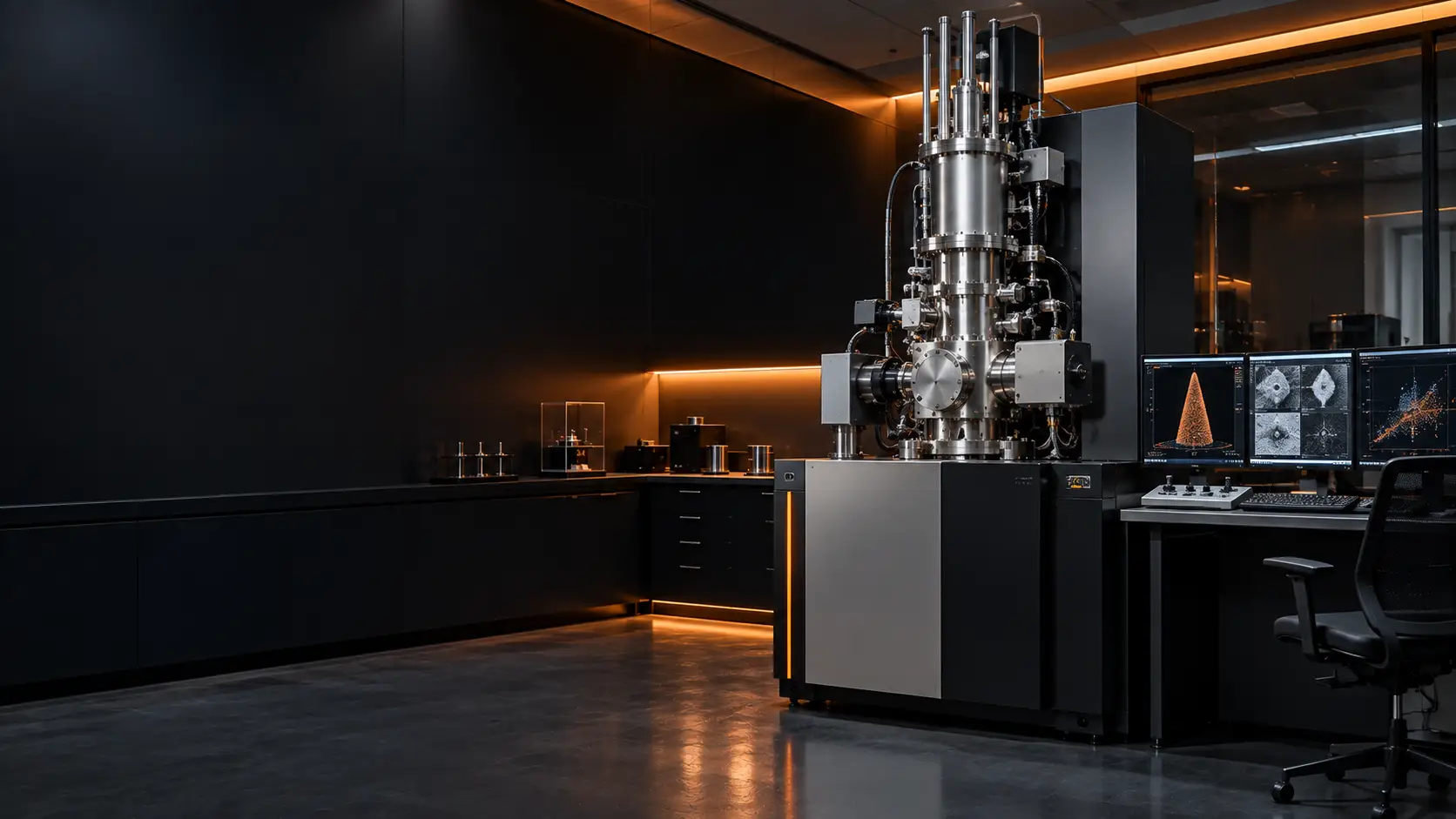
G-Hexa supports atom probe tomography APT analysis in India for investigating three-dimensional elemental distribution, dopant profiles, solute segregation, nanoscale clusters, interfaces, and composition variations in suitable advanced materials. The recommended APT route is confirmed after reviewing your sample and objective.
Advanced alloys, semiconductors, thin films, interfaces, precipitate-containing materials, and other suitable needle-preparable specimens.
3D composition, dopant profiling, segregation, clusters, precipitates, grain-boundary chemistry, and interface analysis.
Share the material, target region, sample condition, expected elements, and analytical objective so APT suitability can be reviewed.
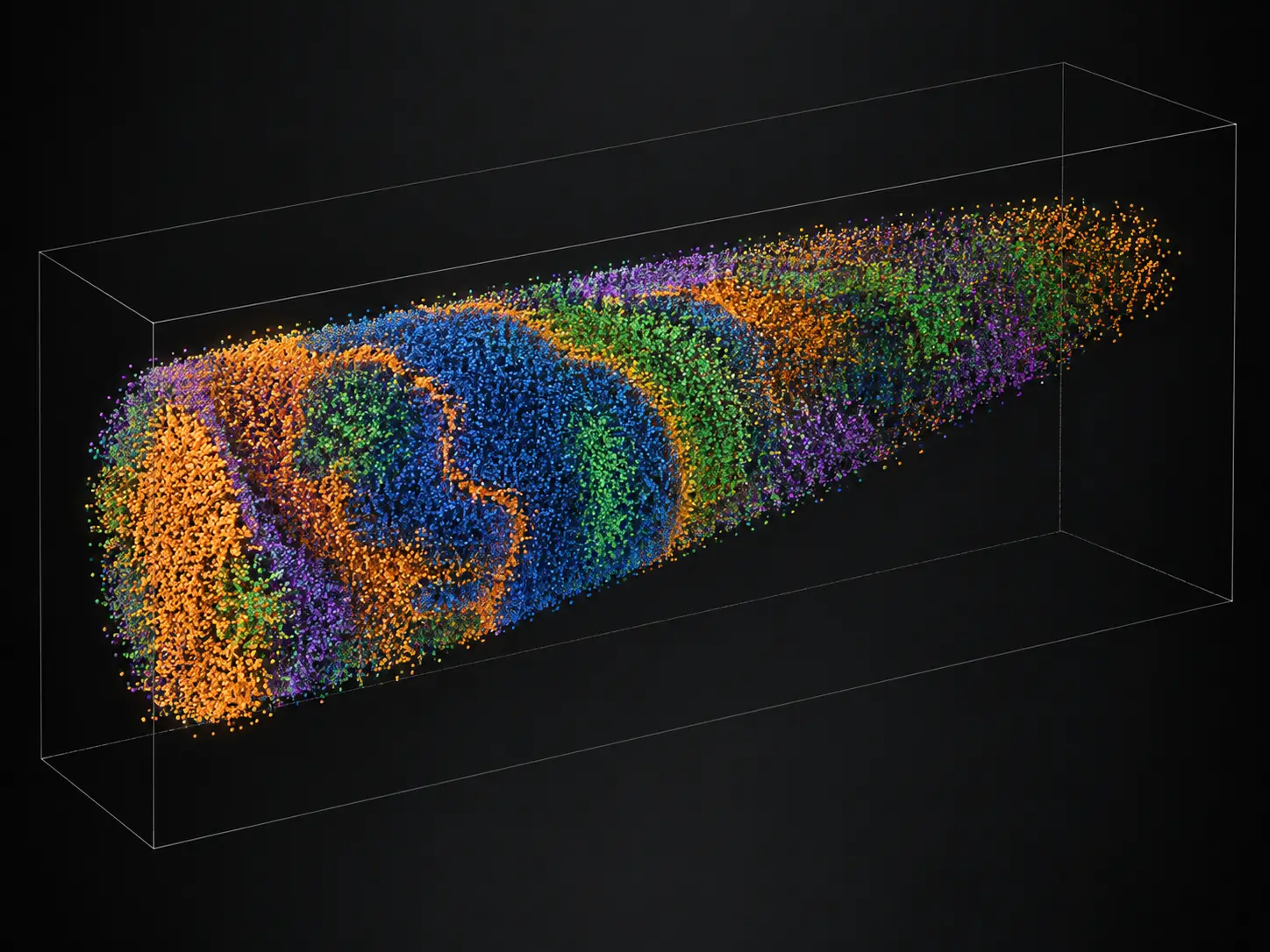
Atom probe tomography is a three-dimensional analytical method that can map the position and chemical identity of detected atoms within a nanoscale volume. It is used when the distribution of elements is as important as the average composition.
APT can help investigate local chemistry, segregation, nanoscale clusters, precipitates, interfaces, and dopant distributions in suitable needle-shaped specimens.
The exact APT workflow depends on the sample, target region, preparation route, expected elements, and information required from the reconstruction.
Map detected atoms within a reconstructed nanoscale volume to investigate local chemical distribution and spatial relationships.
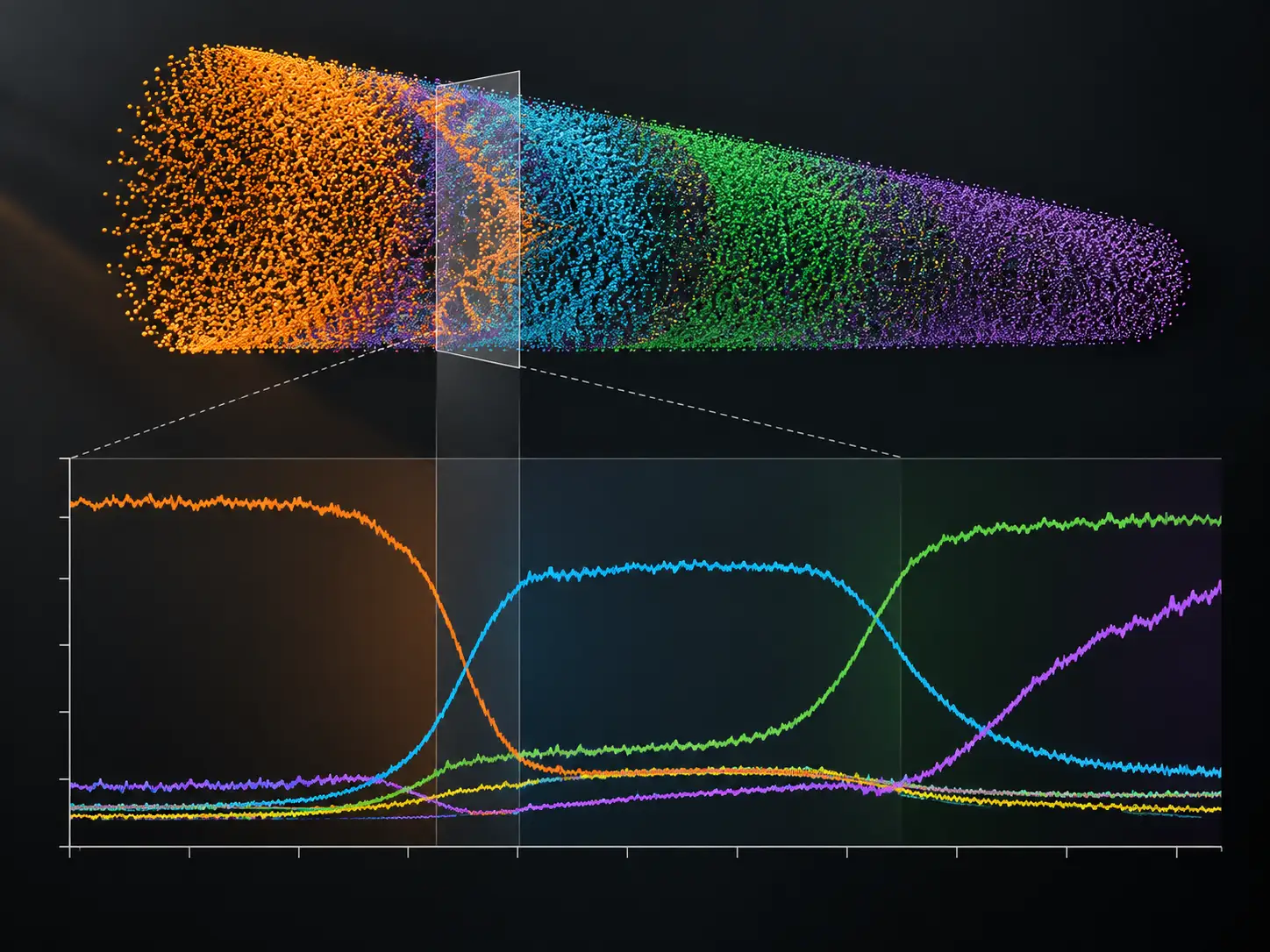
Investigate concentration changes, dopant profiles, solute enrichment, and composition variations across a selected region.
Examine interface chemistry, segregation, clusters, precipitates, and other local features where the sample is suitable for APT.
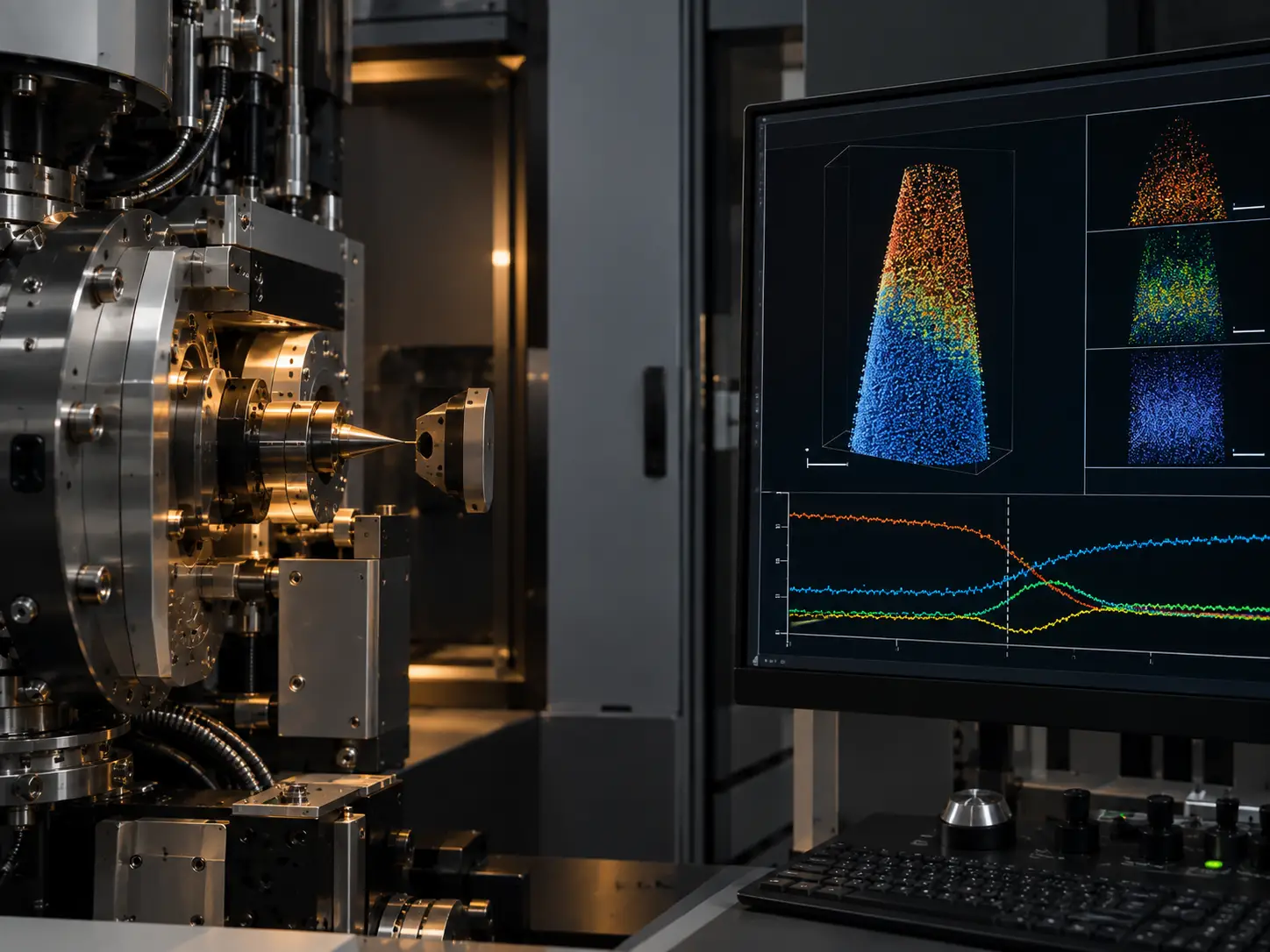
APT uses a sharp, needle-shaped specimen exposed to a high electric field. Atoms are field-evaporated from the specimen surface and travel toward a position-sensitive detector.
The measured arrival time helps provide chemical information, while the impact position contributes to the spatial reconstruction. Computational reconstruction then creates a three-dimensional representation of the detected atoms.
Tap the specimen or detector to see its role in APT.
A needle-shaped specimen is placed in a high electric field. Individual ions are field-evaporated from the apex and travel to a position-sensitive detector. Their arrival time and impact position are used to estimate chemical identity and reconstruct a three-dimensional atom map.
APT can help examine how elements are distributed across a nanoscale volume rather than reporting only a bulk average. Composition profiles can be used to investigate enrichment, depletion, interfaces, dopant regions, and local segregation.
Interpretation depends on the reconstruction, detected species, specimen preparation, analysis volume, and the objective agreed for the work.
APT is used when nanoscale chemistry and three-dimensional distribution are central to a materials or semiconductor question. It is particularly relevant to advanced alloys, doped materials, interfaces, and nanoscale precipitate studies.
Dopant distribution, nanoscale interfaces, composition gradients, and local defects.
Solute segregation, precipitates, clusters, and grain-boundary chemistry.
Layer chemistry, interface composition, and nanoscale concentration changes.
Local chemical distribution and nanoscale features where the specimen is suitable.
APT requires careful consideration of specimen geometry, target location, preparation route, and analytical objective. Share the details first so suitability can be assessed.
Tell us the material, target region, expected elements, condition, and objective.
Our technical team reviews whether the material and target region are suitable for APT.
Needle preparation and site-specific preparation requirements are discussed before submission.
Receive the reconstruction, profiles, observations, and agreed reporting outputs.
Atom probe tomography is used to investigate three-dimensional elemental distribution at the nanoscale. Common objectives include dopant profiling, solute segregation, precipitates, clusters, grain-boundary chemistry, and interface composition in suitable specimens.
APT may be suitable for advanced alloys, semiconductors, thin films, interfaces, precipitate-containing materials, and other materials that can be prepared into suitable needle-shaped specimens. Suitability depends on composition, geometry, stability, and preparation feasibility.
Yes. APT generally requires a sharp needle-shaped specimen with the target region positioned near the apex. The preparation route depends on the material, target location, dimensions, and stability, and must be reviewed before submission.
An APT reconstruction can provide a three-dimensional visualization of detected atoms and support composition profiles, spatial distribution, segregation, clusters, precipitates, or interface observations where the data and material are suitable.
Share the material type, target region, expected elements, sample dimensions, condition, processing history if relevant, and the specific nanoscale question you want to investigate. Photographs and diagrams of the target region are helpful.
Last reviewed: September 30, 2026
Share a few details for a technical review, or speak directly with our consultant by phone or WhatsApp.
Just a few details — our technical team will guide you.