
EBSD objectives
Grain orientation, texture, phase mapping, recrystallization, grain boundaries, local misorientation, and deformation studies.

EBSD analysis maps crystallographic orientation, grain structure, phase distribution, texture, recrystallization, and local misorientation in suitable crystalline materials. G-Hexa reviews the material, surface preparation, expected phases, and analysis objective before confirming an EBSD workflow.
Grain orientation, texture, phase mapping, recrystallization, grain boundaries, local misorientation, and deformation studies.
Metals, alloys, ceramics, geological materials, welds, additively manufactured parts, and other suitable crystalline samples.
Share the material, surface preparation, expected phases, region of interest, sample dimensions, and mapping objective.

Electron backscatter diffraction records diffraction patterns from a prepared crystalline surface. The indexed patterns can be used to determine crystal orientation and support maps of grains, phases, boundaries, texture, and local orientation variation.
EBSD quality depends strongly on surface preparation, material crystallinity, sample geometry, beam conditions, pattern quality, and the mapping step size.
The appropriate EBSD workflow depends on the material, surface finish, expected phases, mapping scale, and the crystallographic question being investigated.
Map crystallographic orientation, grain boundaries, grain size, and orientation relationships across a selected region.
Identify suitable phases and investigate preferred orientation, texture components, and phase distribution.
Support studies of local misorientation, strain-related orientation variation, recovery, and recrystallized regions.
A polished crystalline sample is positioned at a tilt inside an SEM. The electron beam interacts with the near-surface crystal lattice and produces an electron backscatter diffraction pattern.
An EBSD detector captures the pattern, software indexes the bands, and the indexed data are assembled into orientation, phase, texture, boundary, or local-misorientation maps.
Tap a component to see its role in EBSD analysis.
The sample is polished and tilted in the SEM, the electron beam generates a diffraction pattern, the EBSD detector captures it, and indexing software converts the patterns into orientation, phase, texture, grain-boundary, and local-misorientation maps.
EBSD orientation maps show how individual grains are oriented relative to the sample or a selected reference direction. This can support analysis of texture, preferred orientation, grain boundaries, deformation, recrystallization, and processing effects.
Interpretation depends on indexing quality, step size, surface preparation, phase library, cleanup settings, and the crystallographic question being asked.
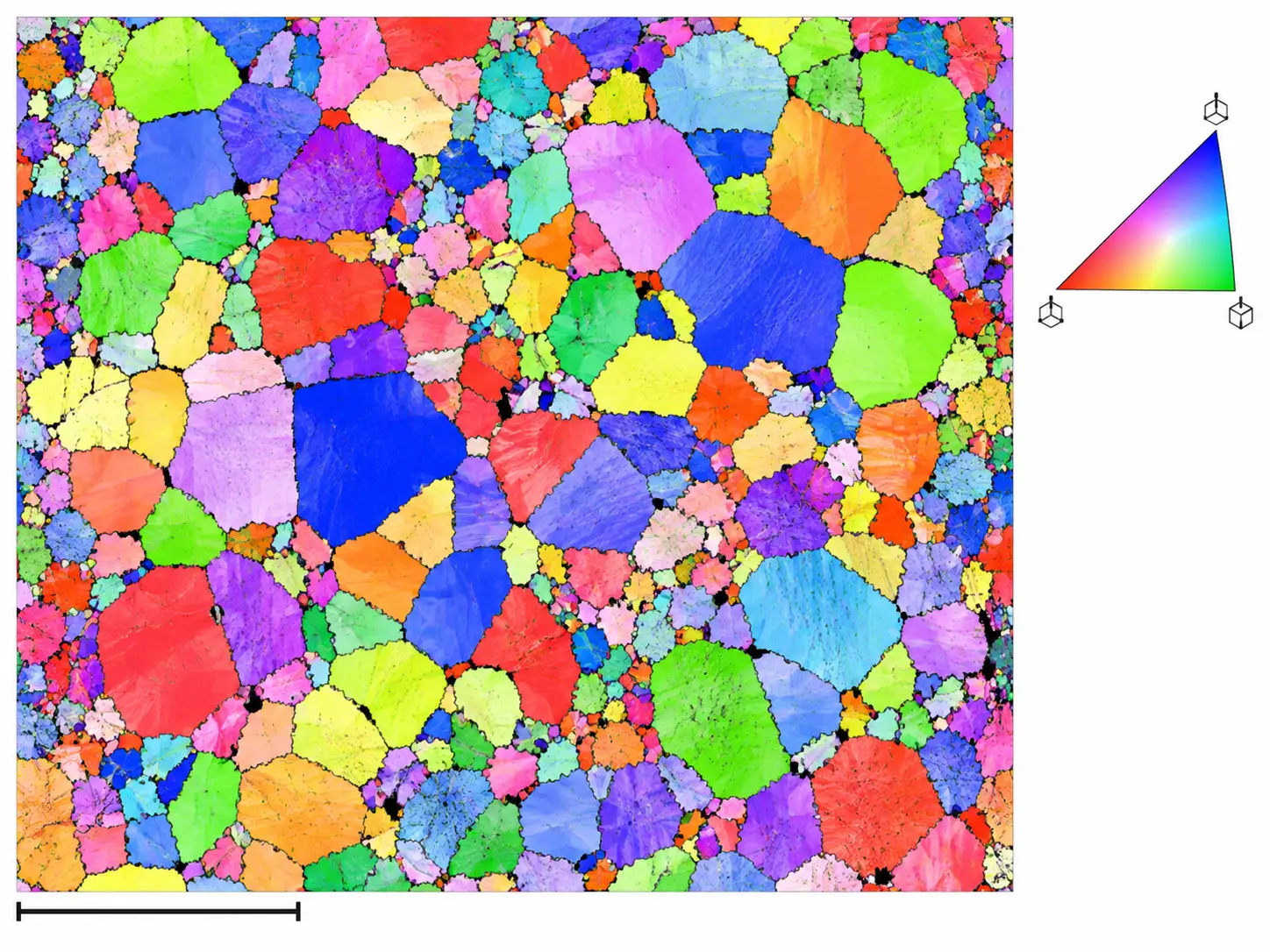
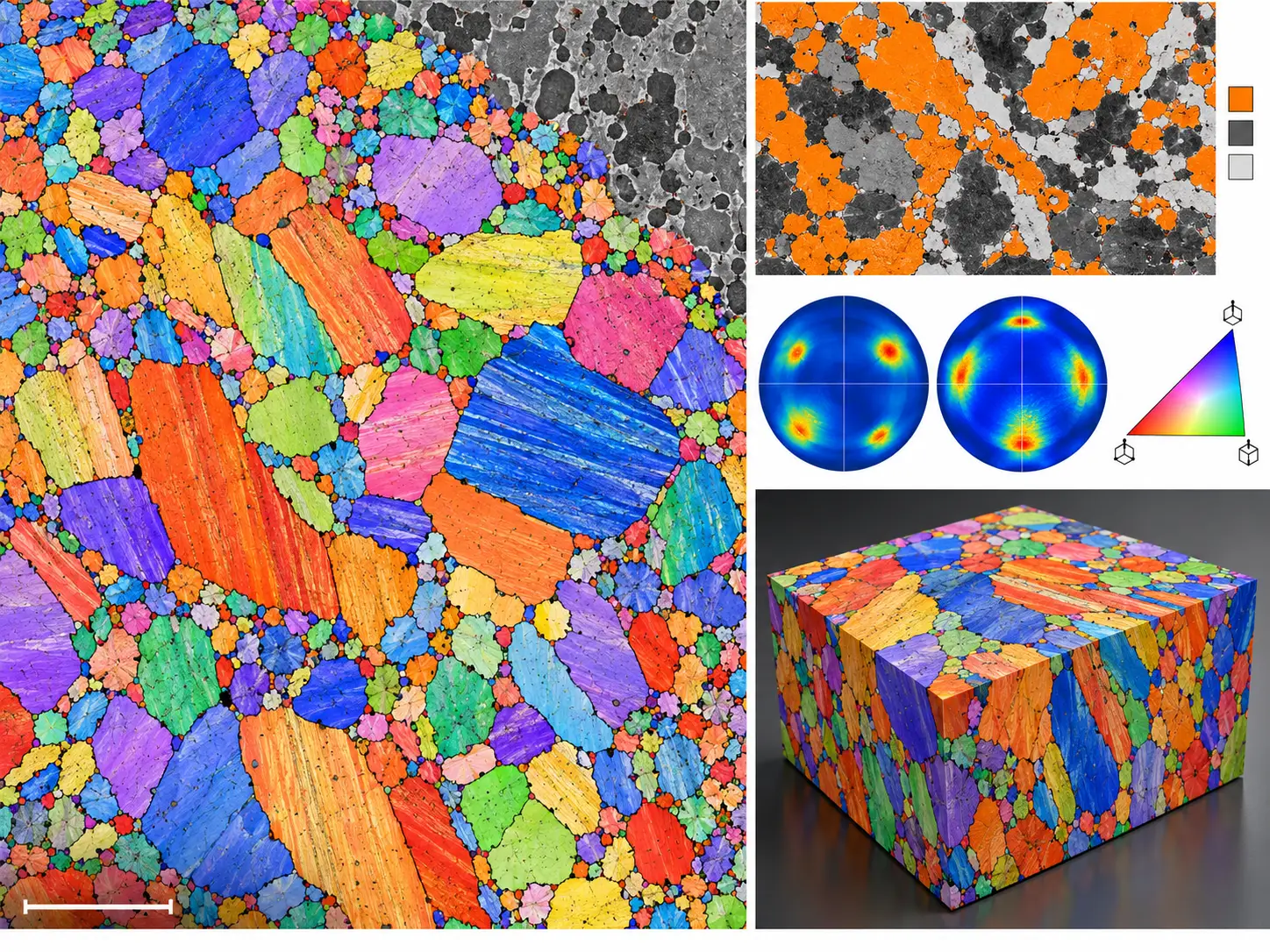
EBSD is used when crystallographic orientation and microstructure are important to understanding processing, performance, deformation, phase distribution, or failure.
Grain structure, texture, phase distribution, recrystallization, deformation, and processing effects.
Orientation changes, phase regions, grain growth, transformation, and weld-process effects.
Build-direction texture, melt-pool microstructure, grain morphology, and local orientation variation.
Deformation, recrystallization, phase changes, and microstructural causes of component behavior.
EBSD requires a suitable crystalline surface and careful preparation. Share the details first so the surface, mapping scale, and expected phases can be reviewed.
Tell us the material, dimensions, phase information, region of interest, and crystallographic objective.
Our technical team reviews crystallinity, surface preparation, geometry, and expected EBSD signal quality.
Discuss mapping area, step size, phase library, orientation reference, and requested outputs.
Receive Kikuchi patterns, orientation maps, phase maps, grain statistics, texture outputs, and agreed documentation.
EBSD analysis is used to map crystallographic orientation, grain boundaries, phase distribution, texture, recrystallization, deformation, and local misorientation in suitable crystalline materials.
EBSD may be suitable for metals, alloys, ceramics, geological materials, welds, additive-manufactured parts, and other crystalline samples with a suitably prepared surface.
EBSD patterns originate from near-surface crystal information. Deformation, scratches, contamination, roughness, or surface damage can reduce pattern quality and indexing reliability, so preparation must be appropriate for the material and objective.
EBSD can provide Kikuchi patterns, orientation maps, inverse pole figure maps, phase maps, grain-boundary information, texture outputs, grain statistics, and local-misorientation information where suitable.
Share the material, sample dimensions, surface-preparation condition, expected phases, target region, required map resolution, and the crystallographic or microstructural question you want to investigate.
Share a few details for a technical review, or speak directly with our consultant by phone or WhatsApp.
Just a few details — our technical team will guide you.